
Crawl Space Insulation in Paramount, CA
Energy-Saving Crawl Space Insulation in Paramount, CA for Paramount, CA Homes — Licensed & Insured
Need crawl space insulation in Paramount, CA? Fresh Paramount Insulation offers expert installation, encapsulation & removal. Call 562-784-9133 for a free estimate.
- Licensed & Insured
- Locally Owned & Operated
- Free Inspection & Estimate
Request Your
Free EstimateCrawl space insulation is the process of thermally and moisture-sealing the underfloor cavity beneath your home, preventing energy loss, moisture intrusion, and pest infiltration from the ground up. For homeowners in Paramount, CA, this service is especially critical given the region’s unique combination of Mediterranean climate swings, clay-heavy soils that retain ground moisture, and an aging housing stock that was largely built before modern energy codes took effect.
At Fresh Paramount Insulation, we specialize in professionally assessing and installing crawl space insulation tailored to the specific demands of Paramount properties. Whether you’re dealing with drafty hardwood floors, spiking utility bills, or a musty odor creeping into your living space, our team brings hands-on local expertise to every job. Call us today at 562-784-9133 to schedule your free crawl space evaluation.
Understanding Crawl Space Insulation
A crawl space is the shallow, unfinished area beneath many single-story and split-level homes that provides access to plumbing, electrical wiring, and HVAC ductwork without requiring a full basement. Crawl space insulation involves installing thermal barriers — using materials such as fiberglass batts, spray foam, or rigid foam board — along either the subfloor joists above or the foundation walls below, depending on the encapsulation strategy chosen.
Historically, crawl spaces in Southern California were often left uninsulated or minimally insulated because the mild climate made energy losses seem less urgent than in colder states. However, as energy costs climbed through the 1970s oil crisis and into the 21st century, California Title 24 energy standards began requiring meaningful thermal performance even in temperate zones like Los Angeles County. Paramount, incorporated as a city in 1957, saw its primary residential building boom occur between the late 1940s and the mid-1970s — a period when crawl space insulation was rarely installed to modern standards.
In Paramount specifically, the majority of housing units are single-family detached homes ranging from 900 to 1,800 square feet, many of which sit on raised wood-frame foundations with vented crawl spaces. This construction type is extremely common in the Gateway Cities corridor — which includes Paramount, Downey, Lynwood, and South Gate — and it means a large share of local homes have direct soil-to-subfloor exposure that drives moisture and thermal problems year-round.
Modern crawl space insulation goes beyond simply stuffing fiberglass batts between floor joists. Today’s best practices include vapor barriers, conditioned or semi-conditioned encapsulation strategies, and air sealing at rim joists and foundation vents — all of which work together to create a sealed thermal envelope that dramatically improves comfort and indoor air quality.
Understanding the difference between a vented and an encapsulated crawl space is essential before choosing an insulation approach. Vented crawl spaces rely on passive airflow to control moisture, while encapsulated crawl spaces are sealed and often include a dehumidifier. In Paramount’s climate — where summer humidity spikes can push relative humidity above 70% during Santa Ana wind reversals and marine layer periods — encapsulation often delivers the best long-term performance.
Why Crawl Space Insulation Is Needed in Paramount, CA
Clay Soils and Ground Moisture
The dominant soil type throughout Paramount and the surrounding Gateway Cities area is Montebello clay loam and Ramona sandy loam — both of which have low permeability and high water retention. During the wet season (November through March), these soils saturate quickly and release moisture vapor slowly, pushing ground humidity directly into uninsulated or under-insulated crawl spaces. The 2022–2023 wet season, which brought record rainfall totaling over 18 inches to the Los Angeles Basin between December and March, caused widespread moisture intrusion in Paramount crawl spaces and led to a notable spike in mold remediation calls across ZIP code 90723.
Temperature Variability and Energy Loss
Although Paramount’s climate is mild by national standards, daily temperature swings of 25–35°F between overnight lows and afternoon highs are common, particularly in September and October during Santa Ana wind events. These thermal swings cause uninsulated subfloors to act as radiators in summer and heat sinks in winter, making interior floors uncomfortably hot or cold and forcing HVAC systems to work significantly harder. Homes without proper crawl space insulation in Paramount typically lose 15–25% of their heating and cooling energy through the floor, according to Department of Energy estimates for similar climate zones.
Aging Housing Stock
Neighborhoods like Old Town Paramount near Alondra Boulevard and the Grayson Avenue corridor contain dense concentrations of post-WWII tract homes built between 1945 and 1965. These homes were constructed with minimal or no crawl space insulation, single-pane windows, and uninsulated ducts — a combination that the California Energy Commission has identified as the primary driver of energy inefficiency in older Los Angeles County housing stock.
Proximity to Industrial Activity
Paramount borders the cities of Compton and Downey and hosts significant industrial and warehousing activity along the Artesia Freeway (SR-91) corridor. Ground vibration from heavy freight traffic on nearby I-710 (the Long Beach Freeway) can gradually loosen existing fiberglass batt insulation from joist cavities over time, reducing effective R-values and creating gaps that allow unconditioned air and pests to enter.
Pest Pressure
Paramount’s warm, year-round climate and clay soils create ideal conditions for subterranean termites (Reticulitermes hesperus) and moisture-seeking rodents. Deteriorated or absent crawl space insulation accelerates wood rot, making structural members more attractive to termite colonization — a documented concern in the Rosecrans Avenue residential corridor near the Paramount–Compton boundary.
Signs You Need Crawl Space Insulation in Paramount
Energy and Comfort Indicators
- Floors feel noticeably cold (below 65°F) in winter mornings despite heating being active
- Utility bills spike more than 20% during December–January or August–September
- Uneven room temperatures between first-floor rooms and upper levels
- HVAC system runs continuously without achieving the set thermostat temperature
Moisture and Air Quality Indicators
- Musty or earthy odor inside the home, especially in hallways and bedrooms adjacent to exterior walls
- Visible condensation on windows during winter mornings
- Warping or buckling of hardwood or laminate flooring
- Allergic symptoms (sneezing, itchy eyes) that worsen indoors — may indicate mold spores entering from below
Structural and Pest Indicators
- Sagging or soft spots in floor sections over the crawl space
- Visible insulation falling from joist cavities (a common finding in homes along the Rosecrans Avenue corridor)
- Evidence of rodent activity — droppings, nesting material, or chewed vapor barrier plastic
- Damaged or missing crawl space vent screens
Urgency note: If you observe standing water in the crawl space or detect black mold on wood joists, contact us immediately at 562-784-9133 — these conditions require remediation before insulation installation can proceed.
Our Crawl Space Insulation Process in Paramount
Free On-Site Assessment (1–2 Hours)
Our technician physically enters the crawl space with lighting and moisture meters to measure existing insulation R-values, check for standing water or moisture readings above 19% in wood members, inspect vapor barrier condition, and identify pest activity. We document findings with photographs and provide you with a written report the same day.
Crawl Space Preparation and Debris Removal (Half Day to Full Day)
Before installing new insulation, we remove deteriorated or contaminated existing materials using HEPA-equipped vacuums and containment protocols. Debris, old vapor barriers, rodent nesting material, and damaged insulation are bagged and removed from the property. This step is especially important in older Paramount homes where original fiberglass batts may have absorbed decades of moisture and lost effective R-value.
Rodent Proofing and Vent Sealing (2–4 Hours)
We seal foundation vent openings with mesh or foam depending on the chosen encapsulation strategy, install steel wool and caulk at pipe penetrations, and close any gaps at rim joists. This step is coordinated with our rodent proofing service if active pest evidence is present.
Vapor Barrier Installation (2–4 Hours)
We install a minimum 6-mil polyethylene vapor barrier (upgraded to 10-mil or 20-mil for encapsulation projects) across the entire soil floor, lapping up foundation walls by at least 6 inches and securing with tape and mechanical fasteners. This is the critical moisture defense layer for Paramount’s clay-soil conditions.
Insulation Installation (Half Day to Full Day)
Depending on the selected method, we install insulation in joist cavities, along foundation walls, or as a spray foam air-seal layer. We target a minimum R-19 for floor insulation per California Title 24 requirements, with R-25 to R-30 recommended for older Paramount homes with high infiltration rates.
Air Sealing and Final Inspection (1–2 Hours)
We seal all penetrations, check that duct connections within the crawl space are properly insulated and sealed, and conduct a final moisture reading and visual inspection. Results are photographed and documented.
Client Walkthrough and Maintenance Briefing (30 Minutes)
We walk you through findings, completed work, and maintenance recommendations specific to your Paramount home’s crawl space configuration before we leave the job site.
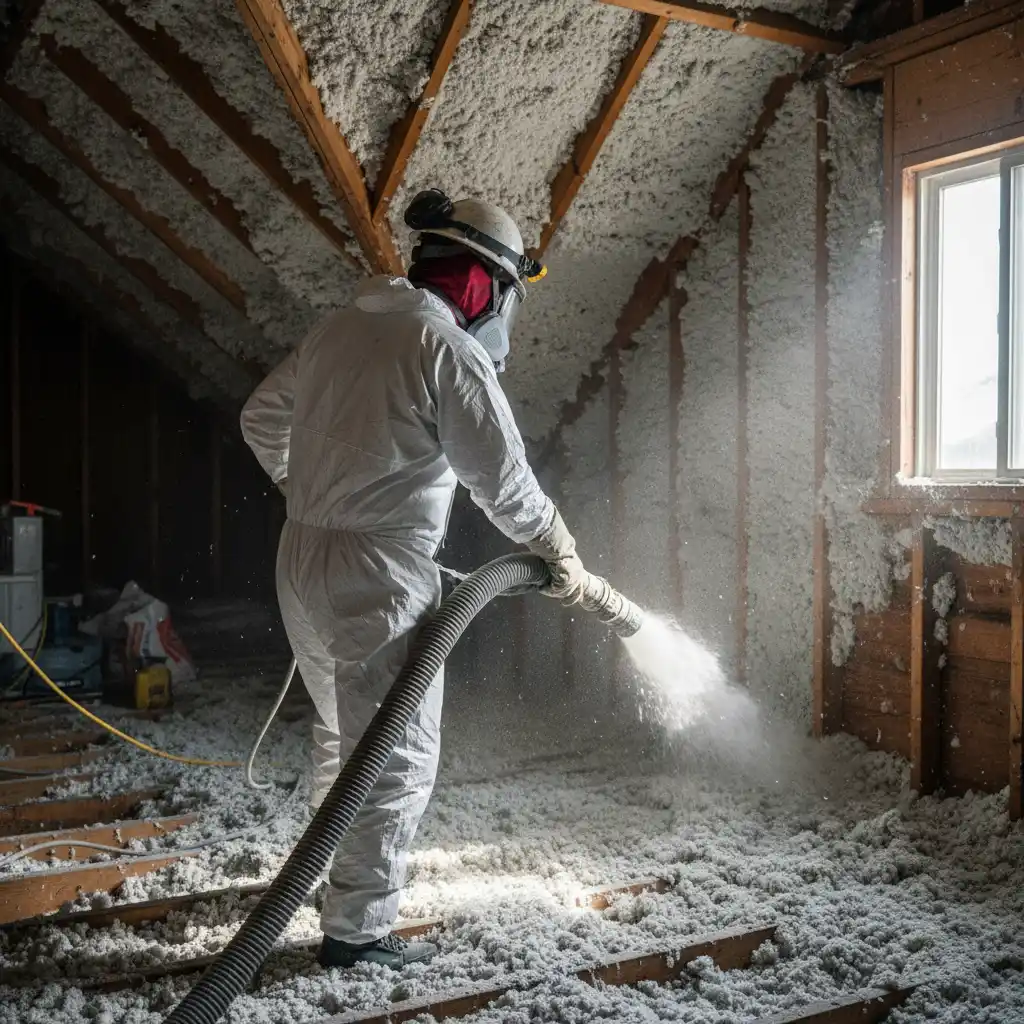
Our team in action — insulation professionals serving Paramount
Crawl Space Insulation Methods and Approaches
Fiberglass Batt Insulation (R-19 to R-25)
Fiberglass batts are installed between floor joists and are the most cost-effective option for vented crawl spaces in good condition. Best suited for Paramount homes with intact vapor barriers and no active moisture issues. Learn more about our fiberglass insulation services.
Spray Foam Insulation (R-6 per inch — Open Cell; R-7 per inch — Closed Cell)
Closed-cell spray foam applied to foundation walls and rim joists creates an airtight seal that is ideal for Paramount homes near the SR-91 corridor where ground vibration and soil movement create gaps in traditional batt insulation. It also acts as a vapor barrier. Explore our dedicated spray foam insulation page for full details.
Blown-In Insulation (R-13 to R-30+)
Blown-in cellulose or fiberglass can fill irregular joist cavities and reach obstructed areas that batts cannot cover effectively. This method is well-suited for older Paramount homes with non-standard joist spacing common in pre-1960 construction. See our blown-in insulation services for more information.
Full Crawl Space Encapsulation
Encapsulation combines a sealed vapor barrier, closed-cell spray foam on foundation walls, conditioned air supply, and a dehumidifier to convert the crawl space into a semi-conditioned zone. This is the premium solution for Paramount homes with persistent moisture problems, particularly those in low-lying areas east of Central Avenue where seasonal water tables rise higher during wet years.
Ready for Crawl Space Insulation? Get Your Free Estimate Today.
Fresh Paramount Insulation serves Paramount and the surrounding area — we’ll be on-site within 24 hours.
📞 Call 562-784-9133Crawl Space Insulation Cost in Paramount, CA
Understanding the cost of crawl space insulation in Paramount helps you budget appropriately and evaluate quotes. Pricing varies based on crawl space square footage, access difficulty, existing conditions, and the insulation method chosen.
Typical Price Ranges
- Basic fiberglass batt installation: $1.50–$2.50 per square foot installed (a 1,000 sq ft crawl space typically costs $1,500–$2,500)
- Blown-in insulation: $2.00–$3.50 per square foot installed
- Closed-cell spray foam (foundation walls and rim joists): $3.50–$7.00 per square foot
- Full encapsulation: $5,000–$15,000 for average Paramount homes, depending on size and dehumidifier inclusion
- Vapor barrier only (6-mil): $0.50–$1.25 per square foot
- Insulation removal (prior to new installation): $1.00–$2.00 per square foot
Factors That Affect Your Cost in Paramount
- Crawl space height: Many post-WWII Paramount homes have crawl spaces as shallow as 18–24 inches, which increases labor time and cost by 15–25%
- Moisture remediation needs: Addressing mold or standing water before insulation adds $500–$3,000 depending on severity
- Access point location: Homes along the Alondra Boulevard corridor often have exterior-only access hatches, increasing setup time
- Los Angeles County permit requirements: Encapsulation projects may require a building permit ($150–$400)
For a precise estimate tailored to your Paramount property, call 562-784-9133 to schedule your free assessment. We provide itemized written quotes with no hidden fees.
Paramount Neighborhoods We Serve
Old Town Paramount (Near Alondra Boulevard and Paramount Boulevard)
The oldest residential area in the city, with homes primarily built between 1945 and 1962. Crawl spaces here often have original tar-paper vapor barriers that have fully degraded, and joist insulation is typically absent or below R-11. We frequently perform full insulation removal and re-installation in this neighborhood.
Grayson Avenue Corridor
A mix of 1960s and 1970s tract housing with standard 2×8 floor joist construction. Many homes here have had partial insulation upgrades that left rim joists and foundation vents unaddressed — common targets for our air-sealing and spray foam supplemental services.
Rosecrans Avenue Residential Area (Near Paramount–Compton Border)
Higher pest pressure and older infrastructure make this area a priority for combined crawl space insulation and rodent proofing packages. Homes here average 1,100–1,400 square feet on slab or raised foundation.
South Paramount (Near Somerset Boulevard)
Slightly newer construction (1970s–1980s) with better baseline insulation but aging vapor barriers and duct systems that benefit from encapsulation upgrades and spray foam rim joist sealing.
Crawl Space Insulation Maintenance Tips for Paramount Homeowners
- Inspect twice yearly: Check your crawl space each fall (October) before the rainy season and each spring (April) after it ends — the two highest-risk periods in Paramount’s climate.
- Check vapor barrier integrity: Look for tears, pooling, or lifted sections after any rainfall event exceeding 1 inch in 24 hours, which occurs several times per season in wet years.
- Clear foundation vents: Remove debris, leaves, and spider webs from vent screens annually to maintain airflow in vented crawl spaces.
- Monitor with a hygrometer: Place an inexpensive wireless humidity sensor in the crawl space; relative humidity above 60% consistently signals a moisture management issue.
- Check for pest intrusion: Look for rodent droppings, chewed insulation, or damaged vapor barrier plastic during every inspection cycle.
- Recheck duct insulation: Confirm that supply and return ducts running through the crawl space maintain their insulation jackets intact — ground vibration from nearby freight routes can loosen duct wrap over time.
- Document your R-values: Keep a record of the insulation type and R-value installed so future contractors or home buyers can confirm compliance with California Title 24 standards.
Why Choose Fresh Paramount Insulation for Your Crawl Space Project
Fresh Paramount Insulation is a locally focused insulation contractor built specifically to serve Paramount and the surrounding Gateway Cities communities. Our technicians understand the specific soil conditions, housing stock, and climate patterns of 90723 and neighboring ZIP codes — and we apply that knowledge on every job rather than applying a one-size-fits-all approach designed for colder or wetter regions.
We provide transparent, itemized written estimates before any work begins, and we communicate clearly throughout every step of the process. Our team is experienced with the full range of crawl space insulation methods — from fiberglass batt replacement in a tight 20-inch post-war crawl space to full encapsulation systems with dehumidification.
In addition to crawl space insulation, we offer a complete suite of insulation services including attic insulation, spray foam, blown-in insulation, insulation removal, attic cleaning, and rodent proofing — meaning we can address all related issues in a single coordinated project. Call us today at 562-784-9133.
Frequently Asked Questions About Crawl Space Insulation in Paramount, CA
How much does crawl space insulation cost in Paramount, CA?
For most Paramount homes, crawl space insulation costs between $1,500 and $5,000 for standard fiberglass or blown-in installations, and $5,000 to $15,000 for full encapsulation systems. Shallow crawl spaces (18–24 inches high) common in the city’s 1940s–1960s housing stock add labor cost. We provide free, written estimates with no obligation.
How long does the installation take?
Most standard crawl space insulation projects in Paramount are completed in one day. Full encapsulation projects including vapor barrier, foundation wall spray foam, and dehumidifier installation typically take one to two days. Homes requiring insulation removal first may add a half day to the schedule.
Do I need a permit for crawl space insulation in Paramount?
Simple insulation replacement generally does not require a permit from the City of Paramount Building and Safety Division. However, full encapsulation that alters the ventilation strategy of the foundation may require a permit. We handle permit identification and coordination as part of our project planning at no additional management fee.
Is crawl space insulation worth it in Southern California’s mild climate?
Yes — even in Paramount’s mild Mediterranean climate. Homes without crawl space insulation lose 15–25% of conditioned air through the floor, and Paramount’s clay soils mean ground moisture is a year-round concern. Most homeowners see measurable reductions in utility bills within the first full annual billing cycle after installation.
What is the difference between a vented and an encapsulated crawl space?
A vented crawl space uses passive airflow through foundation vents to manage moisture, with insulation installed between the floor joists. An encapsulated crawl space is fully sealed — vents are closed, walls are insulated and air-sealed, and a heavy-duty vapor barrier covers the entire floor. Encapsulation is generally recommended for Paramount homes with persistent moisture readings above 60% relative humidity in the crawl space.
Can you insulate a crawl space that has had rodent activity?
Yes, but rodent activity must be addressed before new insulation is installed. We offer rodent proofing services that include exclusion sealing, sanitization, and decontamination of contaminated insulation before fresh material is installed. Installing new insulation over active pest contamination voids its effectiveness and can create health hazards.
What R-value do I need for crawl space insulation in Paramount?
California Title 24 requires a minimum R-19 for floor insulation in Climate Zone 9, which covers Paramount. However, for older homes with high air infiltration rates — particularly those in the Old Town Paramount neighborhood — we recommend R-25 to R-30 for optimal performance and comfort.
How do I know if my existing crawl space insulation needs to be replaced?
Key indicators include fiberglass batts sagging or falling from joist cavities, visible darkening or compression of insulation material, moisture readings above 19% in wood joists, persistent musty odors inside the home, or insulation that appears to have been disturbed by pest activity. Our free assessment includes a full documentation of existing conditions so you can make an informed decision.
Get Your Free Crawl Space Insulation Estimate in Paramount, CA
Don’t let an uninsulated or under-insulated crawl space continue draining your energy budget and compromising your home’s air quality. Whether you’re in Old Town Paramount, the Grayson Avenue corridor, or near the Rosecrans Avenue residential area, Fresh Paramount Insulation is ready to help you protect your home from the ground up.
Call us today at 562-784-9133 to schedule your free, no-obligation crawl space assessment. Our team serves all of Paramount, CA and is available Monday through Saturday for inspections and installations. You can also reach us through our website contact form for a callback within one business day.
Ask about our bundled pricing when combining crawl space insulation with attic insulation or rodent proofing services.